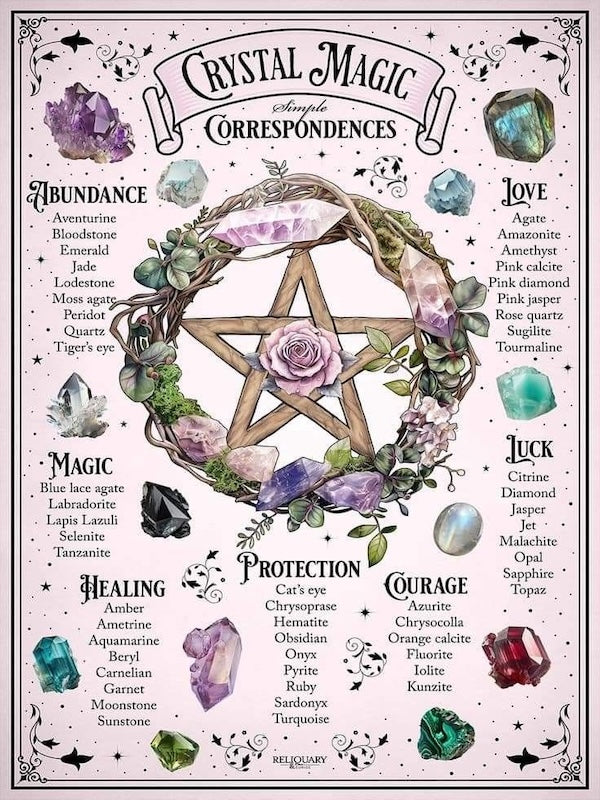
Do Crystals Really Have Magic?
My Answer: Yes, absolutely. Crystals do have magic.
If they can make you feel better, how can that not be considered magic?
People often imagine magic as the kind from Harry Potter—waving a wand and making objects appear out of thin air. However, true "everyday magic" is often the force that subtly changes our perceptions, emotions, and psychological states. Crystals are precisely this kind of existence.
I. The Magic of Psychological Comfort: The Art of Belief
From a psychological perspective, the magic of crystals stems primarily from the Placebo Effect and acting as a Mindfulness Anchor. When you pick up a crystal, such as Rose Quartz, you aren't just picking up a stone; you are picking up a promise of "love and peace." This strong psychological suggestion tells your brain, "I am safe and loved right now." Consequently, your brain releases feel-good chemicals like endorphins, which authentically reduce anxiety and improve well-being.
Furthermore, crystals serve as an "anchor." When your thoughts are a chaotic mess due to stress, touching the crystal’s cool, smooth surface, or observing its unique patterns, helps pull your attention back to the present moment (which is the core of mindfulness practice). This instant of calm is the everyday magic that crystals bestow upon us.
II. The Magic in a Physical Sense: Echoes of Cosmic Vibration
While science does not support crystals directly curing diseases, from a macro perspective of physics and chemistry, they still possess breathtaking "intrinsic properties." These properties themselves are filled with a science-fiction-like sense of magic.
Extreme Orderliness: Crystals possess perfect geometric crystalline structures. In the microscopic world, their atoms are arranged in an extremely regular and stable manner. Compared to the chaotic and disordered things in daily life, this extreme order is itself a healing power. Physics tells us that energy is always flowing and seeking balance; gazing upon or holding such a highly ordered substance might subtly help us regulate our own chaotic energy states, achieving a sort of psychological stability.
Piezoelectric Effect & Vibration: Certain crystals (like quartz) have a piezoelectric effect, meaning they generate a weak electrical charge when subjected to pressure. This leads to their widespread use in watches, computers, and cell phones. While this faint vibration cannot be directly perceived by humans, in a physical sense, crystals are certainly not "dead stones"; they interact with the universe at a unique frequency. How is this inherent, unmapped physical force not considered the magic nature has bestowed upon them?
So, "Do crystals have magic?" The answer doesn't lie in whether crystals themselves possess supernatural powers, but in how you define "magic." If "magic" refers to a power that allows you to quiet your mind in a busy world, to perceive beauty, to generate hope, and to obtain psychological comfort, then yes, crystals absolutely possess magic. They are the concretization of psychological suggestion and the physical crystal of nature’s orderly beauty.